Event Registration for Associations: When the Spreadsheet Stops Working
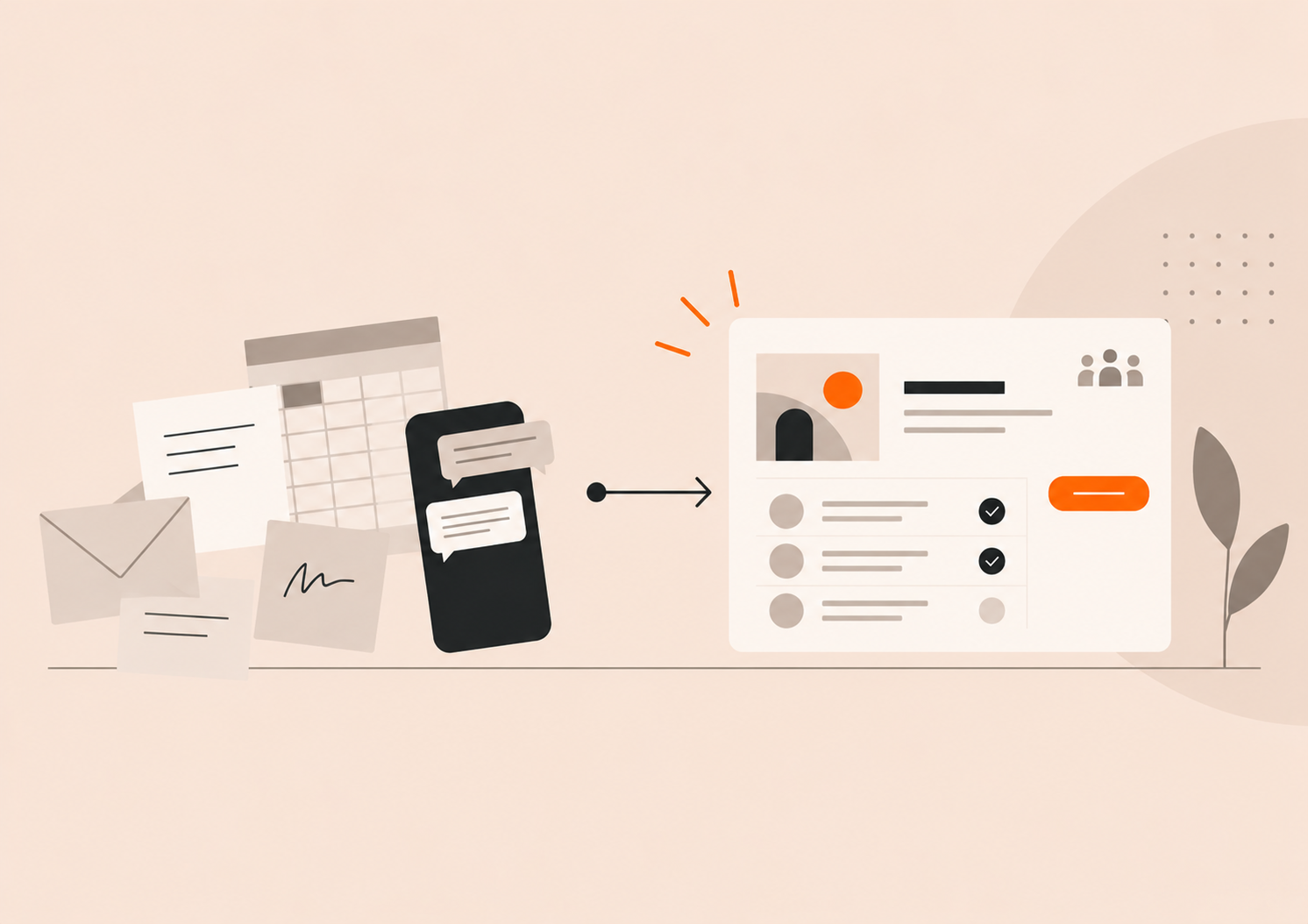
Registrations by email, participant lists in spreadsheets, waiting lists kept in someone's head. What a simple registration system for an association looks like, how much volunteer time it saves — and why funding reports matter more here than people expect.
An association is planning a reading, a workshop, a holiday programme for children. The announcement goes out, and then the part nobody talks about begins.
Registrations arrive by email, some through Instagram, two by WhatsApp to the chair's private number. Somebody transfers them into a spreadsheet. Two people have registered twice, one has misspelled their name, three children have no age listed. Four days before the event two people cancel, but nobody knows who is next on the waiting list — the waiting list is in a different inbox.
On the day, somebody prints the list and ticks names off by hand.
It works. Until it doesn't.
Why this weighs differently for associations than for businesses
A business converts administrative time into money. An association can't, because that time is given voluntarily.
Which is exactly why the damage is greater, not smaller. Volunteer time is the scarcest resource an association has, and it can't be bought. Someone who spends three hours on registration lists spends those three hours doing no programme work, no member support, no funding applications.
And eventually that person does nothing at all, because they step down. The most common reason people leave association boards is rarely the work itself. It's the administration around it.
The item almost nobody thinks about: funding
Anyone receiving public funding — from a district, a city, a foundation — has to document how it was used. That report almost always includes participant numbers. Sometimes broken down by age group, by district, by number of events.
If registrations live in email inboxes and a rotating cast of spreadsheets, those figures have to be pieced together laboriously at year's end. Sometimes they can no longer be reconstructed cleanly at all — and then numbers get estimated that nobody could substantiate if asked.
A registration system solves this as a side effect: the figures accumulate automatically, because they're being recorded anyway. At year's end the report is an export, not an archaeology project.
For associations that apply for funding regularly, this is often a stronger argument than the time saved.
What a registration system for an association actually needs
Not much. But the little it does need has to be reliable.
One form per event. Not a general contact form where people type into a free-text field which date they'd like to attend. A form that asks exactly what this particular event requires.
An automatic confirmation. With the date, time, address and what to bring. This email answers the three questions that would otherwise arrive one by one by phone.
One central list. All registrations in one place, visible to every board member, exportable. Not in one individual's inbox.
A participant limit with a waiting list. Once the course is full, further registrations move automatically to the waiting list. If someone cancels, the next person moves up — without anyone having to check.
A way to cancel. A link in the confirmation email. People who can cancel easily do cancel, instead of simply not turning up. That's the entire trick behind lower no-show rates.
A reminder before the event. One or two days ahead, automatically.
Everything beyond that — payment processing, member discounts, attendance certificates — can come later. It shouldn't be there at the start.
Two particulars that often apply to associations
Members and non-members
Many associations charge different rates for members and guests. The simplest approach is a selection field in the form, not an automatic check against the membership database. The automatic check sounds more elegant but costs considerably more effort, and with modest membership numbers it brings no real advantage.
Events involving children
This calls for particular care. Registrations for children additionally require: consent from a parent or guardian, an emergency contact number, allergy information where relevant — and a separate, voluntary consent for photographs.
The crucial point: photo consent must not be a condition of participation. It belongs in the form as its own field, not pre-ticked, with a clear statement of where the photos will be published. A blanket "I agree to everything" checkbox does not meet this requirement.
Data protection, briefly and practically
Participant lists are personal data. Where children are involved, the protection required is higher. Four points that should be right:
Collect only what's needed. A date of birth is only necessary if there's an age limit. An address only if something will actually be posted.
Data processing within the EU. Form services whose servers sit outside the EU make this unnecessarily complicated.
Define deletion periods. When is registration data deleted? After the event, after the funding report is closed, after a year? The answer should be known within the association and actually carried out.
Control access. Who on the board can reach the list? A shared password in a WhatsApp group does not count as controlled access.
These notes are not legal advice. For larger associations, or where events involving children happen regularly, a review by a lawyer specialising in data protection is worth the cost.
What changes in practice
A realistic picture for an association running eight to twelve events a year:
The effort per event drops from several hours to creating a form and glancing at a list. Duplicate registrations and incomplete entries disappear, because the form has required fields. The waiting list actually functions rather than merely existing. And the figures for the funding report are ready without anyone searching through inboxes in December.
What doesn't change: the association still has to decide who is invited and what the programme looks like. A system removes administration, not substance.
When it isn't worth it
For two events a year with fifteen people each, all from the regular circle, an email and a list are enough. A system would be effort without return.
In practice the threshold sits where waiting lists start to appear, where several people handle registrations at once, or where funding has to be documented. From that point on, it almost always pays for itself.
Planning events that require registration? Send me a short note about how many dates you have coming up and how registrations currently reach you. You'll get an honest assessment — including if the simple solution is the right one.
Related: Automation for small businesses — which processes are actually worth it and Multilingual websites for cultural organisations
Need support with your website?
I help with WordPress fixes, technical SEO, automation and booking systems — pragmatic, without unnecessary overhead.
Get in touchGet in touch