Automation for Small Businesses: Which Processes Are Actually Worth It
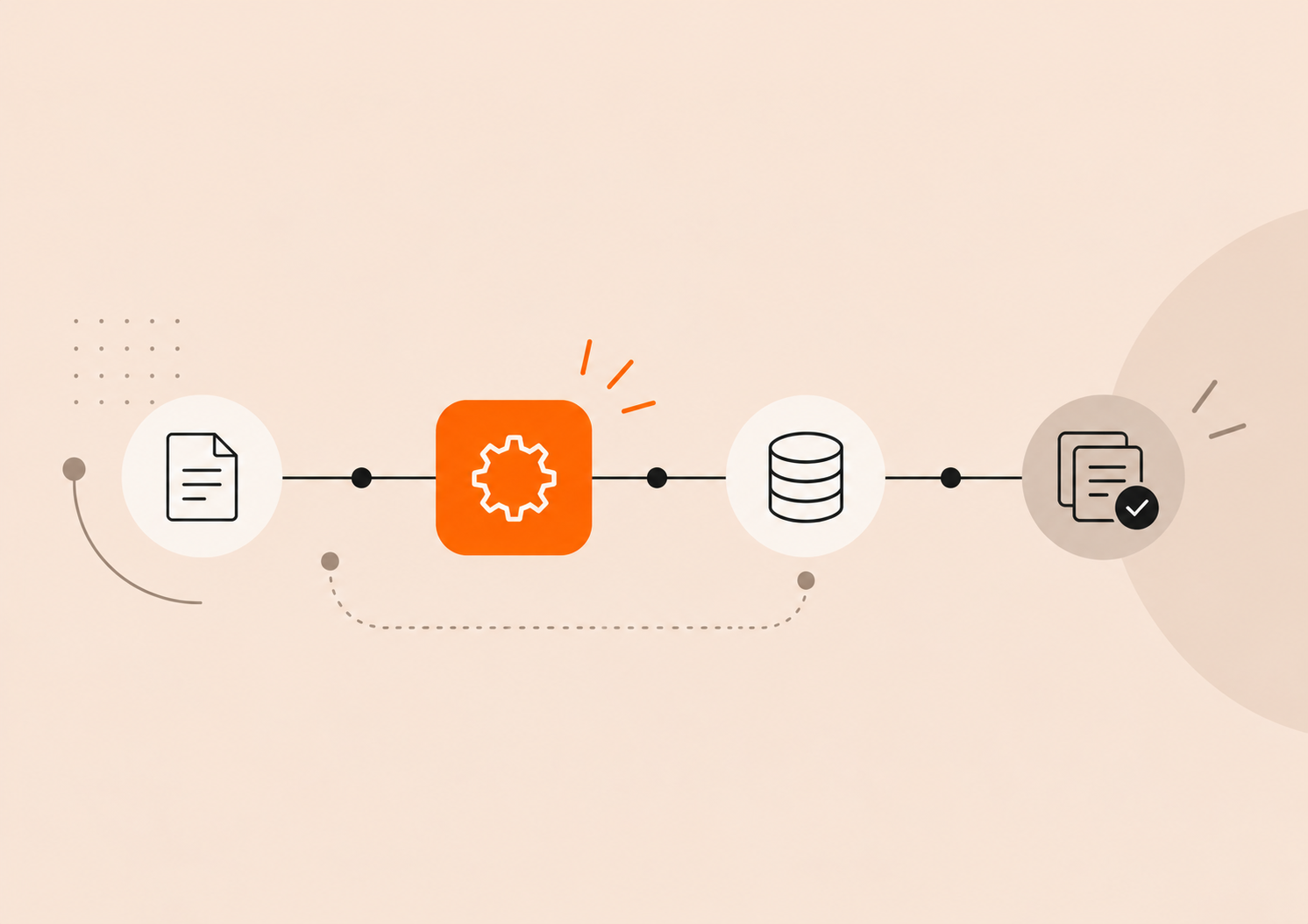
Repetitive admin work costs small businesses several hours a week. Which processes are worth automating, what it costs with n8n — and when the effort doesn't pay off.
Most small businesses don't lose time to big projects. They lose it fifteen minutes here and ten minutes there: copying an enquiry from the contact form into the inbox, entering the appointment into the calendar by hand, typing the same confirmation email for the fortieth time, updating the participant list for the next course in a spreadsheet.
Each individual step is too small to be worth complaining about. Together, in many practices, studios and associations, they add up to four to six hours a week — time that isn't billed and never reaches the client.
These are exactly the steps that can be automated. Not all of them, and not all at once. But the right ones first.
What automation means here
Not artificial intelligence making decisions for you. Not an enormous system that replaces how your business runs.
What's meant is a defined sequence: when X happens, Y follows automatically, and then Z. Someone submits your enquiry form, the entry is saved to a list, the person receives an immediate confirmation carrying your branding, and you get a notification with all the details — without anyone retyping anything.
This isn't new technology. What's new is that it has become affordable for one-person businesses.
Four processes that almost always pay off
1. Enquiries that disappear in the inbox
The most common problem, and the most expensive one. An enquiry arrives on Friday evening, gets buried between newsletters, and by Monday the person has gone elsewhere.
Automated, it looks like this: the enquiry lands in a structured overview, the person receives an acknowledgement within seconds stating a realistic response time, and you can see at a glance what's still open. The acknowledgement alone reduces drop-off noticeably — people who get a reply don't go on to contact the next three providers.
2. Appointment reminders
Missed appointments are the most direct loss a practice or studio can have. An automatic reminder 24 hours in advance, by email or SMS, with a simple way to cancel, reduces no-shows measurably — and cancelled slots free up early enough to be filled again.
3. Course, workshop and event registrations
The typical process without a system: registrations arrive by email, someone transfers them into a spreadsheet, writes confirmations one by one, loses track once a waiting list appears, and shortly before the event nobody is quite sure who is coming.
Automated: one form, one central list, an automatic confirmation with all the details, a waiting list when a date is full, and a reminder before the event.
4. Recurring follow-ups
Invoices still unpaid after 14 days. Prospects who enquired a month ago and never replied. Clients whose last appointment was six months back. None of this gets done reliably by hand — which is why, most of the time, it doesn't get done at all.
What this is built with, and why
For these processes I use n8n, an automation tool with three properties that matter for small businesses in Germany.
It can run on European servers. Appointments, enquiries and participant lists almost always involve personal data, sometimes data that requires particular protection. Tools that route information through US services make data processing agreements unnecessarily complicated. A self-hosted system on an EU server simplifies this considerably.
Costs don't scale with usage. Common automation services charge per executed action. Growth means higher bills — precisely when the system matters most. Running your own instance keeps the cost at the cost of the server.
The credentials stay yours. Your calendar, your spreadsheets, your email sending run through your own accounts, not mine. That isn't a technical detail; it's what keeps you independent.
Day to day, you never see n8n. You see a form, a list and your inbox. The rest happens in the background.
What it costs, and when it pays for itself
A single, properly built process typically sits in the low four figures, plus a modest monthly amount for hosting, monitoring and adjustments.
A worked example — one you should redo with your own numbers:
A practice charging 90 euros per session records three forgotten appointments a month. That's 270 euros monthly, 3,240 euros a year. A reminder system pays for itself within a few months and keeps working afterwards.
Do the same calculation for admin time: four hours a week not spent with clients, at an hourly rate of 60 euros, is roughly 960 euros a month in unused capacity.
The decisive figure isn't the price — it's yours. If you don't know how many enquiries go unanswered or how many hours administration consumes, what you need first is a proper look at the numbers, not an automation.
When automation isn't worth it
So the picture is complete:
- For rare tasks. Something that happens twice a year gets done by hand.
- For processes that don't exist yet. An unclear process doesn't become clearer through automation — it just goes wrong faster.
- For decisions that require judgement. A first conversation, a delicate case, a complaint — that belongs to you, not to a system.
- When ten things are meant to be automated at once. One process that runs reliably is worth more than five half-finished ones.
How a project like this runs
First, a conversation about which process currently costs you the most time — step by step, the way you actually handle it today. That almost always makes it obvious where the biggest lever is.
Then a proposal with a fixed scope and a fixed price, not hourly billing. For a single process, implementation usually takes a few days. After that the system runs, is monitored, and is adjusted when something changes.
The second process tends to suggest itself — once the first one works.
Want to know which process is worth tackling first in your case? Send me a short note about how enquiries or registrations currently reach you. You'll get an honest assessment — including if the answer is that automation doesn't pay off for you yet.
Need support with your website?
I help with WordPress fixes, technical SEO, automation and booking systems — pragmatic, without unnecessary overhead.
Get in touchGet in touch